The Edit / Weaves & Origin
Banarasi, Kanjivaram, Chanderi: How to Tell Them Apart and What You Should Pay
Three GI-protected weaves, three entirely different fabrics — and the price bands that reveal when a "Banarasi" is not one.
Written & reviewed by the Aroha Radiance editor
Published Aug 5, 2026 · 9 min read
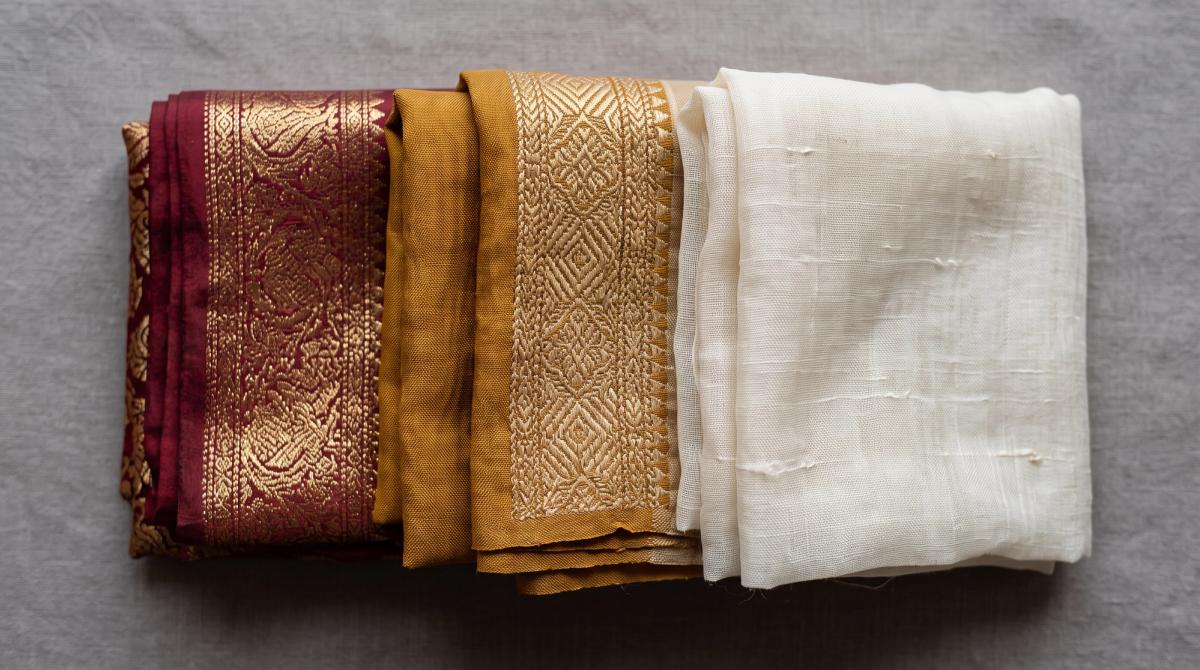
Three names dominate any conversation about Indian silk sarees, and they get used almost interchangeably in online listings. They should not be. Banarasi, Kanjivaram and Chanderi are different fabrics, made in different places by different methods, suited to different occasions, and separated by price gaps large enough that confusing them is an expensive mistake.
All three carry Geographical Indication protection under Indian law. Understanding what that protection actually does and what it conspicuously does not do is the most useful thing a remote buyer can learn about this category.
What a GI tag actually means
A Geographical Indication is a form of intellectual property. Registered under the Geographical Indications of Goods Act, 1999, it restricts the use of a product name to goods originating from a defined region and produced by defined traditional methods.
In practice, this means a saree cannot legally be sold as a Kanjivaram unless it was woven in the specified Kanchipuram cluster to the specified standards. The same applies to Banarasi and Chanderi. The purpose is to stop mass-produced power-loom copies from cities outside the cluster from trading on a name they have no claim to.
Now the part that gets glossed over in marketing copy. A GI tag guarantees geographical origin and traditional production method. It does not certify the quality of any individual piece. Two GI-tagged Chanderi sarees can differ substantially in thread count, zari grade, weave tightness and finish — and therefore in price. The tag tells you what the saree is. It does not tell you whether this particular one is well made.
You can cross-reference registered GI products against the Geographical Indications Registry of India before buying, which is worth doing if a seller is making a claim you want to verify.
Banarasi: Mughal brocade from six districts
Banarasi sarees come from Varanasi and its surrounding region in Uttar Pradesh. The tradition traces to Mughal patronage, and the Persian influence is legible in the motifs intertwining vines, floral butis, kalga-buti arrangements, foliate patterns worked in fine detail.
The technique is brocade. Motifs are woven directly into the fabric using a supplementary weft, rather than embroidered on afterwards. In meenakari work, coloured silk threads are introduced alongside the zari to build the pattern in colour as well as metal.
The GI registration is more geographically generous than most buyers assume. Registered as "Banaras Brocades and Sarees" under GI Application No. 99, with a certificate dated 4 September 2009, it covers six districts of Uttar Pradesh Varanasi, Chandauli, Bhadohi, Jaunpur, Mirzapur and Azamgarh. A saree woven in any of these can legitimately be sold as Banarasi. Conversely, a "Banarasi" produced in Surat, Bhagalpur or Bengaluru is trading on a name it is not entitled to, and this substitution is exactly what the GI registration was pursued to stop.
You may occasionally see the registration described as covering five districts, omitting Jaunpur. The official register lists six.
Named varieties within the tradition include Jangla, Tanchoi, Tissue, Cutwork, Butidar and silk Jamdani. These describe different weave structures and densities, not different quality tiers, so a seller naming one is giving you real information about construction.
Kanjivaram: temple weaving and the korvai ridge
Kanjivaram also spelled Kanchipuram comes from the temple town of Kanchipuram in Tamil Nadu, roughly seventy-five kilometres from Chennai. The weaving tradition there is very old, associated with the Devanga and Saligar weaver communities, and Kanchipuram silk was registered as a Geographical Indication in 2005–06, confined to weavers in the Kanchipuram region of Tamil Nadu.
The defining technical feature, and the one you can actually check, is the korvai method. The border is woven separately from the body of the saree and then interlocked with it. This produces a visible ridge along the join on the reverse of the fabric. If you are shown the back of a saree and there is no interlock ridge where the border meets the body, you are not looking at a korvai Kanjivaram.
The silk is pure mulberry, largely sourced from Karnataka, and the fabric is noticeably heavier than a Banarasi of comparable size. Motifs are bold and geometric where Banarasi motifs are fine and curvilinear: peacocks, elephants, gopuram temple-tower patterns, and the mango or paisley form. The zari is traditionally silver electroplated with gold.
Chanderi: the one that is not pure silk
This is where most confusion happens, because Chanderi sits in the same conversation as two pure silk weaves while being a fundamentally different cloth.
Chanderi comes from the town of Chanderi in Madhya Pradesh and is GI registered. It is typically a silk-cotton blend rather than pure silk, and that blend is the entire point. The resulting fabric is sheer, remarkably lightweight and breathable, with a soft rather than heavy sheen. Traditional motifs coin forms, peacocks, geometric patterns are worked in extra weft technique.
Functionally, this makes Chanderi the daytime and warm-weather option. Summer festivals, daytime ceremonies, sangeet, long events in heat where a heavy Kanjivaram would be punishing. It is elegant without weight.
If a seller describes a Chanderi as "pure silk," treat that as a signal to ask more questions. Some pure silk Chanderi exists, but the classic and most widely sold Chanderi is a blend, and a seller who does not know that may not know much else about the piece.
Realistic price bands
Prices move, and any figure here is a reference band rather than a quote. But the gaps between authentic and imitation are wide enough to be diagnostic.
Genuine GI-certified Kanjivaram in pure mulberry silk with real zari generally starts around several thousand rupees for entry-level festive pieces and rises steeply into six figures for heavy bridal and heirloom work. "Kanjivaram-style" sarees woven on power looms in Surat using art silk start at a small fraction of that. From two metres away in a photograph they can look similar. The fibre, the zari and the lifespan are not remotely similar.
Authentic Banarasi silk starts in the low thousands of rupees for simpler pieces, with heavily worked bridal Banarasi running to a hundred thousand rupees and beyond depending on zari content and weave complexity. Screen-printed "Banarasi print" sarees printed, not woven sell for a few hundred rupees. These are not the same product and should never be priced or described as if they were.
The useful inference is directional. When a listing sits far below the floor of the authentic band, the difference is coming from somewhere: power loom instead of handloom, art silk instead of mulberry, imitation zari instead of metal, print instead of weave. Sometimes all four.
What to ask before you buy
- Which district was it woven in? For Banarasi, any of the six GI districts is a valid answer. Vagueness is not.
- Is there GI documentation, and can you photograph it?
- For Kanjivaram: is it korvai, and can you show me the reverse where the border meets the body?
- For Chanderi: what is the silk-to-cotton ratio?
- Handloom or power loom? This is a separate question from GI status and from Silk Mark.
- What grade of zari pure, half-fine, or imitation?
A seller who answers all six clearly is a seller worth buying from. A seller who deflects on origin is telling you something.
Frequently asked questions
Does a GI tag guarantee the saree is good quality?
No. It certifies regional origin and traditional production method only. Quality within a GI category varies enormously with thread count, zari grade and weave tightness, so you still need to assess the individual piece or buy from a seller you trust.
Which is heavier, Banarasi or Kanjivaram?
Kanjivaram, generally and noticeably. It is woven in heavier mulberry silk with denser zari work. For a long event in heat, that weight is a real consideration.
Is Chanderi suitable for a wedding?
For daytime functions, mehendi, sangeet and warm-weather ceremonies, yes that is where it excels. For a heavy evening reception or as bridal wear, most families would reach for a pure silk weave instead.
Can a Banarasi be made outside Varanasi city?
Yes. The GI covers six districts of Uttar Pradesh, so a saree woven in Chandauli, Bhadohi, Jaunpur, Mirzapur or Azamgarh is legitimately Banarasi. Outside those districts, it is not.
What does "Banarasi print" mean?
It means the pattern is printed onto the fabric rather than woven into it. It is a different product at a different price and should not be presented as a Banarasi saree.
ABOUT THIS ARTICLE
About this article. Compiled from published industry, government and retailer sources, listed below. Prices, duty rates, tax thresholds and certification requirements change frequently verify current figures with the relevant authority before making a purchase or budgeting decision. Figures verified as of 2026.06.30. This article is general information, not legal, financial or customs advice. Aroha Radiance sells no products and receives no commission on anything described here.
A GI tag tells you where a saree is from and how it was made. It does not tell you whether this particular piece is any good.
Put this into practice
Open the Outfit Budget PlannerIn Short
- All three weaves hold Geographical Indication protection, meaning the name is legally restricted to specific districts.
- Banarasi GI covers six districts of Uttar Pradesh, not Varanasi alone.
- Kanjivaram is identified by the korvai technique — a separately woven border interlocked with the body, visible as a ridge on the reverse.
- Chanderi is not pure silk. It is a silk-cotton blend, which is why it is light enough for daytime summer events.
- A GI tag certifies origin and method. It does not certify the quality of the individual piece.
Sources
- 1District Varanasi, Government of Uttar Pradesh — Banaras Brocades and Sarees GI record, certificate dated 04/09/2009
- 2Geographical Indications Registry — Banaras Brocades and Sarees, Application No. 99
- 3IP India — state-wise register of registered Geographical Indications
- 4IP India — GI registration process and legal effect of registration
- 5International Journal of Research – Granthaalayah, "Banarasi Brocade" (2016) — GI district coverage and named weave varieties
- 6ndia Brand Equity Foundation — Geographical Indications of India
Aroha Radiance is a 100% digital AI-generated persona. This article was researched and reviewed by the Aroha Radiance editor. Some visual concepts may be AI-generated.